Fragrance Oil And Aromatic Chemical are two of the most important components in the fragrance industry, yet they are often misunderstood. Many people assume they are the same because both contribute to creating beautiful scents. In reality, they serve different purposes, have different compositions, and are selected based on the final application. Understanding these differences helps perfume manufacturers, cosmetic brands, candle makers, soap producers, and personal care businesses create products with the desired aroma, longevity, and performance.
Whether you are exploring the fragrance industry for the first time or already developing scented products, knowing how fragrance oil and aromatic chemical work together can significantly improve formulation quality. This guide explains every major difference in a simple yet professional manner while helping businesses choose the right ingredients for their fragrance creations.
Understanding Fragrance Oil and Aromatic Chemical
Before comparing both materials, it is important to understand what each one actually represents within fragrance manufacturing. Although both contribute to scent creation, they differ in formulation, composition, production methods, and applications. Learning these fundamentals makes it easier to understand why professional perfumers rely on both rather than choosing only one.
What Is Fragrance Oil?
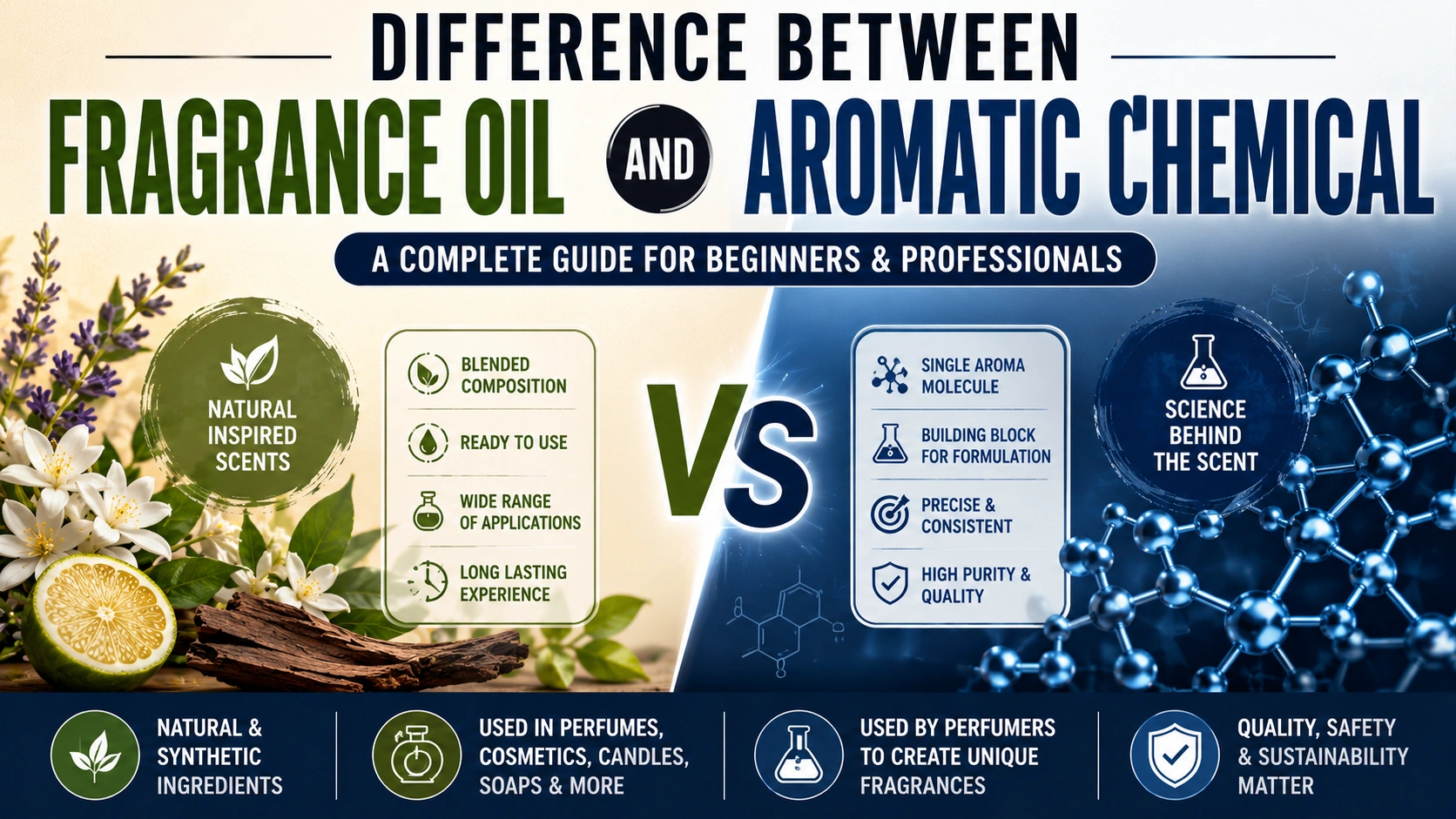
Fragrance oil is a carefully blended aromatic composition created by combining numerous scent ingredients into one finished formulation. These blends are designed to deliver a specific fragrance profile suitable for perfumes, soaps, cosmetics, candles, detergents, air fresheners, and numerous other scented products. Manufacturers balance multiple ingredients to achieve consistency, stability, and long-lasting performance across different applications.
The ingredients used may include natural extracts, botanical isolates, aroma molecules, and carefully selected synthetic materials. Every formulation is tested extensively to ensure it performs well under different temperatures, product bases, and storage conditions while maintaining its intended scent character throughout the product’s lifecycle.
What Is an Aromatic Chemical?
An aromatic chemical refers to a single aroma molecule used as an individual building block during fragrance formulation. Rather than representing a complete scent, it contributes a specific olfactory characteristic such as woody, floral, citrus, musky, creamy, fruity, spicy, or amber-like notes. Professional perfumers combine hundreds of these molecules to develop sophisticated fragrance compositions.
These materials may originate from natural sources or laboratory synthesis depending on the required quality, purity, consistency, sustainability, and availability. Modern perfumery depends heavily on aromatic chemicals because they allow precise fragrance construction that cannot always be achieved using natural ingredients alone.
Key Differences Between Fragrance Oil and Aromatic Chemical
Although both are closely related, several important distinctions separate fragrance oils from aromatic chemicals. Understanding these differences helps manufacturers select suitable ingredients for product development while ensuring better fragrance performance, cost efficiency, and customer satisfaction.
Composition
Fragrance oil is a finished blend containing numerous ingredients carefully combined to create a complete scent profile. Aromatic chemicals, however, consist of individual aroma molecules that perform specific roles inside a fragrance formulation. One is the finished product, while the other serves as one of its essential building blocks.
Manufacturing Process
Fragrance oils require extensive formulation work involving multiple ingredients, stability testing, compatibility assessments, and fragrance balancing. Aromatic chemicals are manufactured individually through extraction, isolation, or advanced synthesis before being supplied to perfumers who later incorporate them into fragrance compositions.
Purpose
Fragrance oils are ready for use in finished consumer products after suitable dilution according to application requirements. Aromatic chemicals are primarily intended for fragrance development, allowing perfumers to construct unique scent profiles from individual aroma materials.
Performance
Aromatic chemicals contribute depth, diffusion, longevity, freshness, warmth, and complexity within fragrance formulations. Fragrance oils combine these characteristics into one balanced composition that delivers a complete sensory experience suitable for commercial products.
What Is the Difference Between Aroma Oil and Fragrance Oil?
This question frequently creates confusion because both terms are used interchangeably in many markets. However, the meanings can vary depending on manufacturers, retailers, and product categories.
Generally, aroma oil refers to scented oils developed primarily for aroma diffusion applications such as diffusers, potpourri, and room fragrance products. Fragrance oil, meanwhile, is formulated for a much broader range of applications including perfumes, soaps, candles, cosmetics, detergents, and skincare products. Professional suppliers often use technical specifications to determine the most suitable application rather than relying solely on marketing terminology.
Core Components Found in Professional Fragrance Formulations
Modern fragrance formulations rely on a combination of carefully selected ingredients that work together to create balanced, long-lasting scents. Each ingredient contributes unique olfactory properties while improving overall fragrance performance across different applications.
- Natural botanical extracts for authenticity and freshness.
- High-purity aroma molecules for consistency.
- Floral, woody, citrus, gourmand, and amber accords.
- Stabilizers that improve fragrance longevity.
- Performance enhancers for better diffusion.
- Fixatives that slow evaporation.
- Carrier materials suitable for different formulations.
- Specialty ingredients that enhance fragrance complexity.
Professional fragrance houses carefully evaluate every component before incorporating it into commercial fragrance oils.
Is Fragrance Oil a Chemical?
Many consumers wonder whether fragrance oils are entirely chemical-based. The answer is more balanced than a simple yes or no.
Every material around us—including water, essential oils, flowers, fruits, and plant extracts—is composed of chemicals at the molecular level. Fragrance oils therefore contain various chemical compounds, but those compounds may originate naturally, synthetically, or through a combination of both. Modern fragrance formulation focuses on safety, stability, sustainability, and consistent performance rather than simply distinguishing between natural and synthetic ingredients.
For instance, premium fragrance compositions often combine natural botanical ingredients with advanced aroma molecules to produce fragrances that remain stable across different climates and product bases while maintaining excellent longevity.
The Role of Essential Oil in Modern Perfumery
Natural materials continue to play an important role within fragrance development despite the advancement of modern aroma chemistry. Essential Oil ingredients provide authentic botanical characteristics that enrich fragrance compositions with natural freshness, depth, and complexity. However, they are often blended alongside carefully selected aroma molecules to improve consistency, sustainability, and long-lasting performance without compromising the overall scent profile.
Examples of Premium Fragrance Materials Used Across the Industry
Leading fragrance manufacturers continuously develop innovative fragrance bases and specialty materials to support perfume, cosmetic, and home fragrance production. Businesses seeking premium fragrance solutions often explore internationally recognized collections for inspiration and performance.
For example, fragrance creators may choose blends like Majestic Eagle Givaudan, Lemony Lemon Givaudan, GIVEX 511426 Givaudan, Abeer Givaudan, Summer Shimmer Exce Inde Givaudan, Daring Avenue Givaudan, Stonewood Givaudan, Most Desired Givaudan, Amber Dreams Givaudan, Black Velvet Givaudan, Lady Macbeth Givaudan, Creative Impact Givaudan, Ambery Nights Givaudan, Gypsy Trail Givaudan, and Salvation Knight Givaudan to support diverse fragrance developments across luxury perfumes, personal care products, fine fragrances, and premium home care applications.
These fragrance compositions demonstrate how expertly balanced formulations can deliver distinctive olfactory experiences while maintaining excellent performance across multiple product categories.
What’s the Difference Between Aroma and Fragrance?
Although both words relate to scent, they describe different concepts within fragrance science and consumer products.
The word “aroma” generally refers to naturally occurring smells associated with food, herbs, spices, flowers, coffee, fruits, and plant materials. “Fragrance,” on the other hand, is a broader term describing intentionally created scent compositions used in perfumes, cosmetics, household products, toiletries, and personal care items. Fragrances may include both natural and laboratory-developed aroma materials to achieve a desired scent profile with better stability and longevity.
Synthetic Ingredients Have Revolutionized Modern Fragrance Development
As the fragrance industry has evolved, manufacturers have embraced innovative raw materials to create scents that are more stable, consistent, and environmentally responsible. While natural extracts remain valuable, modern perfumery depends on scientific advancements to produce fragrances that perform reliably across different climates, product formulations, and storage conditions. This balanced approach enables brands to offer premium fragrances without compromising quality or availability.
One of the biggest innovations in perfumery is the development of Synthetic aroma compounds. These carefully engineered molecules replicate or enhance specific scent characteristics while providing greater consistency than many naturally sourced ingredients. They also help reduce pressure on rare botanical resources, making fragrance production more sustainable without sacrificing creativity or olfactory richness.
How Fragrance Chemicals Build Exceptional Perfumes
Professional perfumers rarely create a fragrance using only natural extracts. Instead, they combine dozens or even hundreds of carefully selected Fragrance chemicals to construct complex scent structures that evolve beautifully over time. Every ingredient contributes a unique role, from creating the first impression to enhancing longevity and ensuring a memorable dry-down.
Rather than overpowering one another, these materials are blended in precise proportions to achieve balance between freshness, depth, projection, and lasting power. The expertise lies not only in selecting high-quality ingredients but also in understanding how they interact with each other throughout the fragrance lifecycle.
Important Aroma Molecules Used in Professional Formulations
Modern fragrance creation depends on individual aroma materials that contribute specific olfactory effects. These ingredients provide perfumers with the flexibility to develop distinctive fragrances for luxury perfumes, skincare products, candles, detergents, room sprays, and personal care formulations.
- ISO E Super IFF creates a smooth woody character with remarkable diffusion.
- Veramoss IFF adds elegant mossy nuances and sophisticated depth.
- Lyral IFF contributes soft floral freshness to carefully balanced compositions.
- Suederal LT IFF introduces luxurious suede and leather-inspired richness.
- Tonquitone IFF enhances warm musky sweetness with impressive longevity.
- Tobacorol IFF delivers refined tobacco nuances suited for premium masculine fragrances.
- BiCyclo Nonalactone IFF offers creamy coconut and milky characteristics.
- Amber Xtreme IFF provides exceptional projection with powerful amber warmth.
- Piconia IFF contributes floral elegance within modern compositions.
- Orivone IFF introduces woody violet-inspired sophistication.
- Dulcinyl Recrystallized IFF creates sweet balsamic smoothness.
- Ambermor EX IFF enhances long-lasting amber depth.
- Muguet Aldehyde 50 IFF delivers delicate lily-of-the-valley freshness.
Each material serves a distinct purpose, demonstrating why individual aroma molecules remain indispensable in contemporary fragrance formulation.
What Are the Ingredients in Fragrance Oil?
Many consumers ask, What are the ingredients in fragrance oil? The answer varies depending on the fragrance profile, intended application, and manufacturer. Premium formulations are carefully balanced to achieve the desired scent, stability, and performance across different product categories.
A professionally developed fragrance oil typically contains several carefully selected components working together rather than relying on a single ingredient. This combination allows manufacturers to produce fragrances that remain consistent throughout production and during long-term storage while maintaining excellent olfactory quality.
Common Components Found in Premium Fragrance Oil And Aromatic Chemical Formulations
Every premium Fragrance Oil And Aromatic Chemical formulation is created using a carefully balanced combination of ingredients that work together to deliver a distinctive, long-lasting scent. While the exact composition varies depending on the desired fragrance profile and its application, professional perfumers rely on several essential components to ensure excellent performance, stability, and consistency.
- Natural botanical extracts that add authentic and rich aromatic character.
- High-purity aromatic molecules that provide consistency and precision in every batch.
- Floral, woody, citrus, fruity, gourmand, spicy, and amber accords that build a well-rounded fragrance profile.
- Fixatives that slow evaporation and enhance fragrance longevity.
- Diffusion enhancers that improve scent projection and overall performance.
- Stabilizing ingredients that maintain the integrity of the formulation during storage and use.
- Carrier materials designed for compatibility with perfumes, candles, soaps, cosmetics, and personal care products.
- Specialty aroma ingredients that create uniqueness, depth, and a memorable fragrance signature.
A professionally formulated Fragrance Oil And Aromatic Chemical blend combines these elements in carefully measured proportions to create fragrances that smell appealing from the very first spray, evolve beautifully through their heart and base notes, and maintain excellent longevity across a wide range of applications.
Selecting the Right Materials for Different Applications
Every scented product has unique formulation requirements. A fragrance that performs exceptionally well in fine perfumery may require adjustments before being incorporated into candles, soaps, detergents, or skincare products. Understanding these application differences helps manufacturers select ingredients that deliver optimal performance while meeting consumer expectations.
Professional formulators evaluate compatibility with waxes, surfactants, alcohol bases, oils, creams, and various cosmetic ingredients before finalizing a fragrance. This detailed testing process ensures consistent scent performance, product stability, and regulatory compliance across multiple industries.
Premium Fragrance Inspirations Used Across the Industry
International fragrance houses continue developing innovative fragrance compositions that inspire luxury perfumes and premium consumer products. These sophisticated blends help manufacturers create distinctive scent experiences for diverse markets while maintaining exceptional quality standards.
Examples include OUD AL IBIN BATTUTA 503554-A LUZI, SWEET ESCAPE 233206-B LUZI, MODERN FICTION 349484-A LUZI, Garden of Delight 160179 – A Luzi, Sentinal 353736 – B Luzi, Indian Necklace 461735 – A Luzi, Wingardium Leviosa 234078 – A Luzi, Fairtale 336347 – A Luzi, Alquitara 339332 Luzi, Calming Time 462490 – A Luzi, Aquatic Man 400029 – A Luzi, OUD Chikha 461966 – A Luzi, Your Majesty 353617 – B Luzi, Alasko 502536 Luzi, Amor Caliente 260895 – B Luzi, Contemporary Elegance 503876 – C Luzi, and Dark Obscure 354523 – A Luzi, each representing different fragrance directions suitable for modern perfumery and personal care innovations.
These fragrance inspirations highlight the creativity possible when carefully selected raw materials are transformed into sophisticated scent compositions for global markets.
Choosing Reliable Aroma Chemical Suppliers Matters
The quality of fragrance ingredients directly influences the performance of finished products. Businesses searching for Aroma chemicals suppliers should evaluate suppliers based on product authenticity, technical expertise, sourcing standards, quality assurance, documentation, and consistent inventory availability. Reliable partnerships help manufacturers maintain product quality while ensuring uninterrupted production schedules and regulatory compliance.
Similarly, organizations purchasing Aroma chemicals wholesale benefit from suppliers capable of providing consistent quality across large production volumes. Bulk procurement becomes significantly more valuable when supported by transparent sourcing, dependable logistics, and comprehensive technical assistance throughout the purchasing process.
Nikunj Enterprises – Your Trusted Fragrance Oil and Aromatic Chemical Partner
Businesses seeking premium fragrance ingredients need a supplier that prioritizes authenticity, consistency, and customer satisfaction. Nikunj Enterprises has established itself as a trusted name by offering high-quality fragrance solutions suitable for perfume manufacturing, cosmetics, personal care products, soaps, candles, detergents, air fresheners, and numerous industrial fragrance applications.
The company works with globally recognized fragrance manufacturers to provide authentic fragrance oils and premium aromatic ingredients that meet modern quality expectations. Whether customers require sophisticated fragrance compositions or specialized raw materials for new product development, Nikunj Enterprises focuses on delivering dependable solutions supported by professional guidance, reliable sourcing, and consistent product quality. This commitment makes the company a preferred partner for businesses seeking Aroma chemicals for fragrance across diverse manufacturing sectors.
Understanding Performance Beyond the Initial Scent
A well-crafted Fragrance Oil And Aromatic Chemical formulation is judged by much more than its first impression. While many consumers focus on the opening notes, professional perfumers evaluate how the fragrance develops from the top notes to the heart and finally the base. A high-quality formulation unfolds gradually, revealing different scent layers that create depth, harmony, and a lasting sensory experience.
The performance of a Fragrance Oil And Aromatic Chemical blend depends on the careful interaction of aromatic molecules, natural extracts, fixatives, performance enhancers, and other supporting ingredients. Together, these components influence fragrance projection, longevity, dry-down, and overall stability across different product applications. This precise balance is what distinguishes professionally formulated fragrances from ordinary scented blends, enabling brands to deliver consistent, memorable, and premium-quality fragrance experiences to their customers.
The Growing Demand for High-Quality Fragrance Ingredients
The global fragrance industry continues to evolve as consumers seek premium scented products that combine long-lasting performance with unique olfactory experiences. From luxury perfumes to skincare, home fragrances, and personal care products, brands are investing in high-quality ingredients that offer consistency, stability, and creativity. This growing demand has encouraged manufacturers to develop innovative fragrance solutions that meet both consumer expectations and international quality standards.
Today, fragrance developers focus not only on creating appealing scents but also on ensuring compatibility with different product bases, regulatory compliance, and sustainable sourcing practices. As a result, both fragrance oil and aromatic chemical remain essential components of modern fragrance manufacturing, working together to produce products that perform exceptionally well across diverse applications.
Premium Fragrance Inspirations That Support Modern Formulations
Leading fragrance houses continuously introduce sophisticated fragrance creations that inspire manufacturers across multiple industries. These fragrance compositions help businesses develop products that cater to changing market preferences while maintaining superior performance and excellent fragrance stability.
Some remarkable examples include Orient Air Argeville, Woobian Extreme Argeville, Awakening Oud Argeville, Koala Strong Argeville, Moon Snake Argeville, Whimsical Argeville, Cast Away TFR Argeville, Lottery Luxury Elixir Argeville, Bourbon Royal TFR Argeville, Imagine Bahia Argeville, Paranoid Black Argeville, English Explorer Argeville, Athar Select Argeville, Centaurus Argeville, Athar Noirwood Argeville, Casino Royal VIP Argeville, Promise Them Oud Argeville, and Diego Ocean Argeville. These fragrance inspirations represent diverse olfactory directions ranging from fresh aquatic compositions to rich woody, oriental, gourmand, and luxurious amber profiles suitable for premium fragrance development.
How to Choose the Right Fragrance Ingredients
Selecting fragrance ingredients involves much more than choosing a pleasant scent. Manufacturers evaluate numerous technical and commercial factors before finalizing materials for a formulation. Making informed decisions helps improve product performance while ensuring consistency across production batches.
- Define the intended application before selecting fragrance materials.
- Evaluate fragrance stability in the final product base.
- Verify supplier authenticity and quality certifications.
- Review technical documentation and regulatory compliance.
- Test fragrance performance under different environmental conditions.
- Consider consumer preferences and target market expectations.
- Assess scalability for future production requirements.
- Choose suppliers offering reliable technical support.
Following these practices enables manufacturers to create products that consistently deliver an excellent sensory experience.
Quality Testing Ensures Reliable Fragrance Performance
Professional fragrance development involves rigorous testing before products reach the market. Every formulation undergoes detailed evaluation to verify stability, compatibility, diffusion, longevity, and overall performance. This process minimizes formulation issues while ensuring the fragrance behaves consistently across various product categories.
Manufacturers often perform accelerated stability testing, compatibility assessments, storage evaluations, and application-specific performance studies. These procedures help identify potential formulation challenges early, allowing necessary adjustments before commercial production begins. Comprehensive quality testing ultimately protects both manufacturers and consumers by ensuring dependable product performance.
Sustainability Is Shaping the Future of Fragrance Oil And Aromatic Chemical
The future of Fragrance Oil And Aromatic Chemical manufacturing is increasingly driven by sustainability and responsible innovation. As consumers become more environmentally conscious, brands are prioritizing fragrance ingredients that are ethically sourced, produced through eco-friendly manufacturing practices, and developed with minimal environmental impact. This shift is encouraging fragrance manufacturers to create high-quality scent solutions that balance performance with sustainability.
Modern advancements in Fragrance Oil And Aromatic Chemical production focus on renewable raw materials, biodegradable ingredients, energy-efficient manufacturing processes, and responsible sourcing partnerships. Green chemistry and innovative fragrance technologies are making it possible to develop sophisticated, long-lasting fragrances while reducing the industry’s environmental footprint. By embracing sustainable practices, manufacturers can continue delivering premium fragrance solutions that meet evolving consumer expectations and support long-term environmental conservation.
Comparing Fragrance Oil and Aromatic Chemical
The following comparison highlights the major differences between both fragrance materials and their respective roles within professional fragrance development.
| Feature | Fragrance Oil | Aromatic Chemical |
|---|---|---|
| Composition | Complete fragrance blend | Individual aroma molecule |
| Purpose | Ready-to-use fragrance composition | Building block for formulations |
| Usage | Perfumes, soaps, candles, cosmetics, home care | Professional fragrance formulation |
| Complexity | Multiple ingredients blended together | Single functional ingredient |
| Development | Finished fragrance creation | Raw material selection |
| Performance | Complete scent profile | Specific olfactory contribution |
| Flexibility | Limited customization after formulation | High flexibility during fragrance development |
| End User | Product manufacturers | Perfumers and fragrance formulators |
Understanding these distinctions helps businesses select appropriate materials based on production goals, formulation complexity, and desired fragrance characteristics.
Common Misconceptions About Fragrance Ingredients
Many misconceptions continue to circulate regarding fragrance oil and aromatic chemical. Clarifying these misunderstandings helps manufacturers and consumers make informed decisions when selecting fragrance materials.
One common myth is that natural ingredients are always safer or superior to laboratory-developed materials. In reality, both natural and synthetic ingredients undergo extensive evaluation before being used in professional fragrance formulations. Their suitability depends on safety assessments, formulation compatibility, and intended application rather than origin alone.
Another misconception is that aromatic chemicals produce artificial-smelling fragrances. Professional perfumers carefully combine multiple ingredients to create balanced, elegant compositions. Individual aroma molecules are selected because they contribute specific scent characteristics that enhance realism, longevity, and complexity within the finished fragrance.
Final Thoughts: Explored Fragrance Oil and Aromatic Chemical
Choosing between fragrance oil and aromatic chemical should never be viewed as selecting one over the other. Instead, both play complementary roles within modern perfumery. Fragrance oils provide complete, ready-to-use scent compositions, while aromatic chemicals offer the precision required to build and refine those fragrances from the ground up.
Manufacturers who understand the strengths of each ingredient type can develop products that deliver outstanding scent performance, stability, and customer satisfaction. Whether producing fine fragrances, cosmetics, candles, soaps, detergents, or home fragrance products, selecting authentic ingredients from reliable suppliers remains the foundation of successful fragrance development.
As the fragrance industry continues advancing through innovation, sustainability, and scientific research, the partnership between expertly formulated fragrance oils and carefully selected aromatic chemicals will remain essential for creating memorable scents that meet the evolving expectations of consumers worldwide.
Frequently Asked Questions (FAQs)
1. Can fragrance oil and aromatic chemical be used together?
Yes. Professional perfumers routinely combine fragrance oils with carefully selected aromatic chemicals to enhance fragrance complexity, longevity, balance, and overall performance in various scented products.
2. Are aromatic chemicals safe for cosmetic applications?
When sourced from reputable manufacturers and used according to applicable regulations and recommended usage levels, aromatic chemicals are widely utilized in perfumes, cosmetics, personal care products, and household fragrances.
3. Which industries commonly use fragrance oils?
Fragrance oils are extensively used in perfume manufacturing, skincare products, haircare formulations, soaps, candles, detergents, air fresheners, incense, home fragrances, and numerous personal care applications.
4. Why is supplier quality important in fragrance manufacturing?
Authentic suppliers provide consistent product quality, proper documentation, reliable sourcing, technical support, and regulatory compliance. These factors help manufacturers produce stable, high-performing fragrance products while maintaining customer trust.
5. How do professionals create long-lasting fragrances?
Long-lasting fragrances are achieved by carefully balancing aromatic materials, fixatives, fragrance accords, and supporting ingredients. Extensive testing and precise formulation ensure the fragrance develops beautifully from the opening notes to the final dry-down while maintaining excellent longevity.