
FESTIVE DEAL Shubh Deepavali: FLAT 5% OFF On All Products Storewide!*

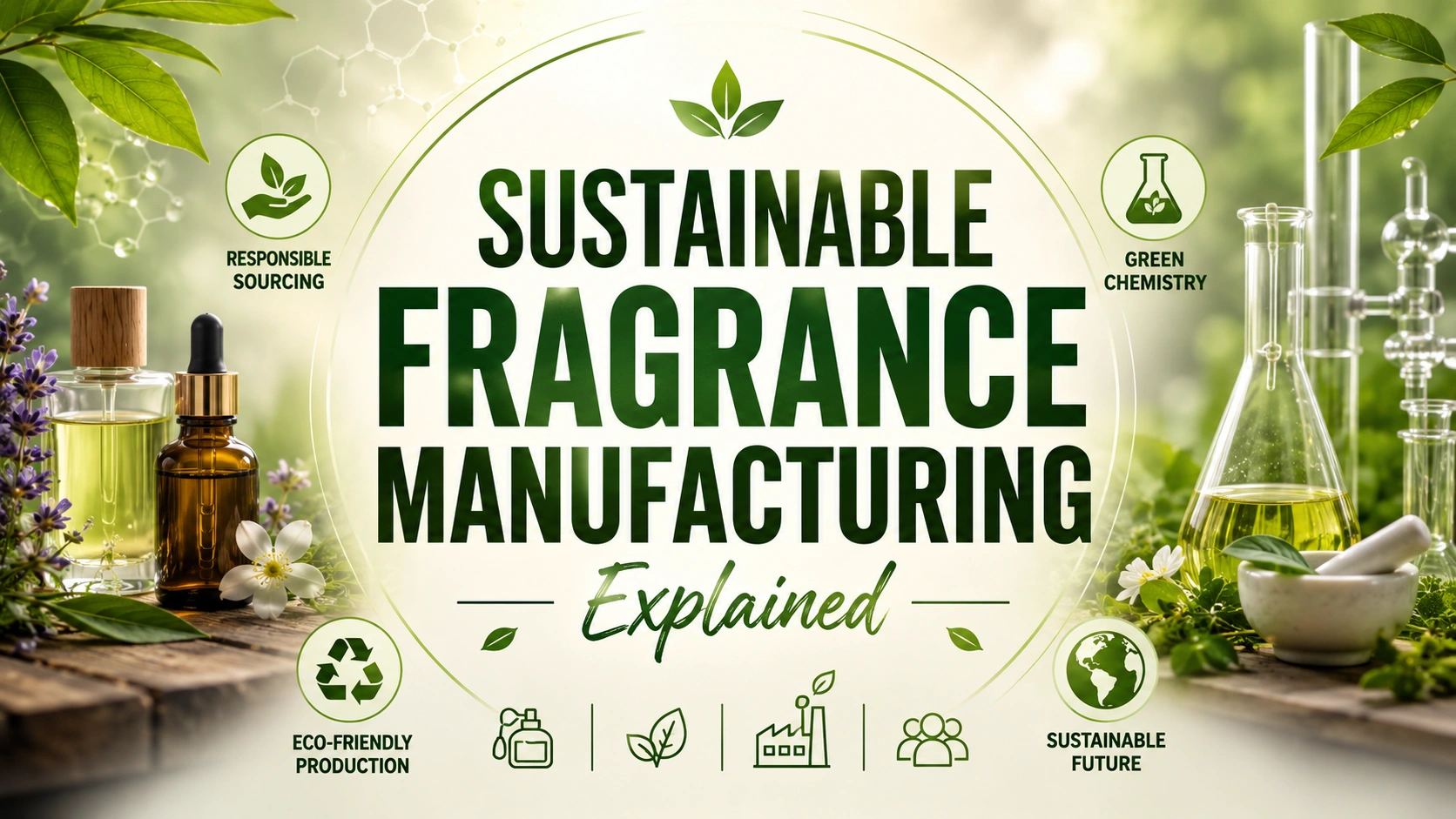
Sustainable Fragrance Manufacturing Explained

Fragrance Manufacturing

Fragrance Manufacturing is transforming rapidly as the global fragrance industry embraces sustainability, innovation, and responsible sourcing. Modern consumers expect beautiful scents that not only smell exceptional but also respect people and the planet. From ingredient selection to production technologies, every stage now contributes toward creating fragrances with a lower environmental footprint while maintaining outstanding performance and quality.

The fragrance industry has always blended creativity with science, but sustainability has become an equally important pillar. Manufacturers are investing in greener chemistry, renewable resources, ethical sourcing, and efficient production systems to meet growing expectations. These initiatives help reduce waste, conserve natural resources, and deliver premium fragrance solutions for perfumes, cosmetics, home care, personal care, and industrial applications.

What Makes Sustainable Fragrance Manufacturing Important?

Sustainability is no longer a marketing trend. It has become a fundamental business strategy that shapes how Fragrance Manufacturing is developed, tested, produced, packaged, and delivered. Manufacturers are under increasing pressure to reduce environmental impact while maintaining consistency, innovation, and regulatory compliance across global markets.

A sustainable approach improves operational efficiency while supporting biodiversity and responsible resource management. By minimizing emissions, optimizing energy usage, and selecting renewable ingredients wherever possible, fragrance businesses create long-term value for customers, suppliers, and communities alike. This balanced strategy strengthens consumer trust and encourages continuous innovation throughout the supply chain.

Modern consumers carefully evaluate the environmental practices of brands before making purchasing decisions. Businesses that adopt sustainable production methods often experience stronger customer loyalty because transparency and responsible manufacturing inspire confidence. Sustainable Fragrance Manufacturing therefore benefits both environmental goals and commercial success simultaneously.

Research laboratories also play an important role in sustainable development. Scientists continuously explore safer molecules, renewable ingredients, biotechnology solutions, and advanced extraction techniques that reduce waste without compromising olfactory performance. These innovations help manufacturers create fragrances that satisfy evolving market expectations while supporting environmental conservation.

Building Sustainability from the Source

Every sustainable fragrance begins with responsible ingredient selection. Manufacturers collaborate with farmers, botanical suppliers, aroma chemical producers, and research organizations to ensure ingredients are obtained through ethical and environmentally responsible practices. Sustainable sourcing improves product quality while protecting ecosystems and supporting local communities.

Natural ingredients require careful cultivation because climate conditions, harvesting methods, and soil quality significantly influence fragrance profiles. Responsible farming practices help preserve biodiversity while ensuring long-term availability of valuable aromatic crops. These initiatives create stronger partnerships between manufacturers and agricultural communities across multiple regions.

Synthetic aroma molecules also contribute significantly to sustainable fragrance creation. Many modern aroma chemicals reduce dependence on limited natural resources while delivering excellent stability, consistency, and safety. Through continuous innovation, laboratories develop high-performance ingredients that minimize environmental impact without sacrificing fragrance complexity.

Core Principles Behind Sustainable Production

Successful sustainable fragrance production combines environmental responsibility with technical excellence. Leading manufacturers focus on several interconnected principles that improve efficiency throughout the manufacturing process.

  • Responsible sourcing of renewable raw materials
  • Reduced energy consumption across manufacturing facilities
  • Water conservation through advanced recycling systems
  • Waste reduction using optimized production processes
  • Ethical partnerships throughout the supply chain
  • Continuous innovation using green chemistry technologies

These principles create a manufacturing ecosystem that supports environmental protection while maintaining premium product performance for customers across various industries.

Green Chemistry is Changing the Industry

Green chemistry has become one of the strongest drivers behind sustainable fragrance innovation. Scientists carefully redesign chemical processes to reduce hazardous substances, improve production efficiency, and maximize raw material utilization. These improvements reduce waste generation while delivering consistent fragrance quality suitable for demanding commercial applications.

Biotechnology has also expanded opportunities for producing aroma molecules using renewable biological processes. Instead of relying exclusively on conventional extraction or petrochemical sources, manufacturers increasingly explore fermentation and bio-based production techniques. These methods often require fewer resources while supporting long-term sustainability objectives.

Digital manufacturing systems further improve production accuracy through automated monitoring and intelligent process control. Precise measurements reduce unnecessary material losses and optimize manufacturing efficiency. These technological advancements demonstrate how innovation and sustainability work together to strengthen the fragrance industry.

Responsible Supply Chains Create Better Fragrances

A sustainable fragrance cannot exist without a transparent and responsible supply chain. Manufacturers increasingly evaluate suppliers based on environmental practices, labor standards, ethical sourcing, and quality assurance. Strong partnerships encourage continuous improvement throughout every stage of ingredient procurement and production.

Traceability allows companies to verify ingredient origins and monitor compliance with sustainability commitments. This transparency builds confidence among customers who seek products manufactured with responsible environmental and social practices. Reliable documentation also simplifies regulatory compliance across international markets.

Supplier collaboration encourages knowledge sharing and innovation. Farmers, ingredient producers, laboratories, logistics providers, and manufacturers work together to improve cultivation methods, reduce transportation emissions, and enhance production efficiency. These collective efforts strengthen sustainability across the entire fragrance ecosystem.

The Growing Role of Innovation

Innovation remains the foundation of sustainable fragrance development. Advanced analytical technologies help researchers understand ingredient performance with greater precision, allowing them to formulate fragrances using fewer resources while maintaining exceptional olfactory characteristics. Scientific progress continuously expands possibilities for sustainable manufacturing.

Artificial intelligence, predictive modeling, and digital formulation platforms are also influencing fragrance research. These technologies accelerate development cycles by identifying promising ingredient combinations before physical testing begins. Faster innovation reduces unnecessary experimentation and minimizes material consumption during product development.

Manufacturers also invest heavily in cleaner production equipment that improves efficiency while lowering environmental impact. Modern machinery enables precise blending, reduced emissions, optimized heating systems, and improved resource utilization, creating measurable sustainability improvements across manufacturing operations.

Choosing Reliable Industry Partners

Selecting experienced manufacturing partners significantly influences fragrance quality and sustainability outcomes. Businesses often evaluate expertise, technical capabilities, quality certifications, innovation capacity, and responsible sourcing practices before establishing long-term supplier relationships.

Organizations searching among Fragrance manufacturing companies should carefully assess production standards, regulatory compliance, research capabilities, and commitment to environmental responsibility. Strong manufacturing partners provide consistent quality while supporting sustainable business growth through transparent operations and continuous innovation.

Similarly, businesses sourcing fragrance ingredients benefit from suppliers who prioritize traceability, ethical procurement, and scientific excellence. These characteristics ensure reliable supply chains capable of meeting evolving customer expectations across multiple industries.

Sustainable Manufacturing Benefits Multiple Industries

Sustainable fragrance production supports far more than luxury perfumes. Fragrance Manufacturing serves personal care products, home cleaning solutions, fine fragrances, candles, cosmetics, fabric care formulations, hospitality products, and wellness applications, all of which benefit from environmentally responsible fragrance development.

Manufacturers design fragrance solutions according to specific application requirements while maintaining sustainability objectives. Improved ingredient compatibility, formulation stability, and regulatory compliance help businesses deliver better products that satisfy increasingly environmentally conscious consumers through advanced Fragrance Manufacturing practices.

Industrial customers also appreciate sustainability because efficient production often reduces operational costs through improved resource management. These savings create opportunities for long-term investment in research, quality improvements, and innovative fragrance technologies.

Quality Assurance Remains Essential

Sustainability never replaces quality; instead, it strengthens it. Every fragrance undergoes extensive analytical testing, stability evaluation, safety assessment, and performance verification before reaching commercial production. These quality control systems ensure consistency regardless of production scale.

Modern laboratories utilize sophisticated analytical instruments capable of identifying even minor variations within fragrance compositions. Accurate testing supports batch consistency while helping manufacturers optimize formulations that align with sustainability objectives and customer expectations.

Comprehensive documentation further strengthens quality assurance by providing traceable manufacturing records, ingredient verification, and regulatory compliance. These systems improve transparency while supporting continuous process improvements throughout production.

Innovation Through Premium Ingredients

Many sustainable fragrance formulations combine carefully selected specialty ingredients with innovative aroma molecules to create memorable olfactory experiences. For instance, premium fragrance creations may incorporate Eternal Mermaid Givaudan, Classic Safari Givaudan, GIVEX 54099 Givaudan, GIVEX 69328 MX Inde Givaudan, and Daring Avenue Givaudan to develop refined fragrance profiles suitable for multiple commercial applications.

Manufacturers also explore sophisticated woody and oriental compositions using ingredients like Chandan Pure Givaudan and Amber Dreams Givaudan, allowing perfumers to achieve excellent depth while maintaining formulation flexibility. These fragrance solutions demonstrate how innovation and sustainability can successfully complement each other within modern product development.

Why Responsible Manufacturing Creates Long-Term Value

Companies investing in sustainable operations gain advantages that extend beyond environmental benefits. Improved resource efficiency lowers production costs, stronger supplier relationships enhance reliability, and transparent manufacturing practices build customer confidence. Together, these factors create a competitive advantage within increasingly demanding global fragrance markets.

Businesses seeking dependable Fragrance manufacturers in India increasingly prioritize organizations demonstrating sustainability leadership alongside technical expertise. Responsible manufacturing has become an important differentiator because customers now value environmental stewardship almost as highly as fragrance performance itself.

As sustainability expectations continue to evolve, manufacturers must balance scientific innovation, commercial viability, regulatory compliance, and environmental responsibility. This integrated approach ensures fragrance production remains both economically successful and environmentally sustainable for future generations.

The Role of Responsible Ingredient Selection in Modern Production

Fragrance Manufacturing continues to evolve as ingredient sourcing becomes more transparent, scientific, and environmentally responsible. Every fragrance begins with carefully selected raw materials that meet quality, safety, and sustainability standards. Manufacturers now evaluate every ingredient not only for its aromatic performance but also for its environmental footprint and long-term availability.

Responsible sourcing encourages partnerships with trusted growers, extraction specialists, and aroma chemical producers who follow ethical business practices. This approach improves supply chain resilience while ensuring fragrance ingredients remain consistent across production batches. Sustainable ingredient selection also supports biodiversity, protects natural habitats, and creates positive economic opportunities for farming communities.

Innovation has made it possible to balance natural ingredients with advanced aroma molecules that deliver remarkable performance while reducing pressure on limited botanical resources. This thoughtful combination allows perfumers to create sophisticated fragrances without compromising environmental responsibility or product excellence.

Many businesses searching for a dependable Perfume raw Material supplier now prioritize suppliers that maintain complete ingredient traceability, strict quality documentation, and internationally recognized manufacturing standards. These characteristics improve confidence throughout the supply chain while helping manufacturers consistently meet customer expectations.

Technology is Shaping the Future of Sustainable Fragrance Manufacturing

The fragrance industry increasingly depends on modern technologies that improve precision, efficiency, and sustainability. Digital automation minimizes production errors while optimizing ingredient usage, energy consumption, and manufacturing consistency. Advanced monitoring systems allow manufacturers to control every stage of production with exceptional accuracy.

Artificial intelligence also assists fragrance researchers by analyzing ingredient compatibility and predicting formulation performance before physical trials begin. This technology shortens development cycles, reduces unnecessary laboratory experiments, and minimizes material waste without affecting fragrance quality or creativity.

Biotechnology represents another exciting advancement. Renewable biological processes can now produce selected aroma molecules through environmentally friendly methods that require fewer natural resources. These scientific breakthroughs help manufacturers reduce emissions while maintaining excellent fragrance performance across multiple product categories.

Sustainable Packaging Completes the Manufacturing Journey

Manufacturing responsibility extends beyond fragrance creation. Packaging decisions significantly influence the overall environmental impact of fragrance products. Companies increasingly select recyclable materials, lightweight containers, refillable packaging systems, and responsibly sourced paper products to reduce waste throughout the product lifecycle.

Improved packaging designs also reduce transportation emissions because lighter materials require less energy during distribution. Manufacturers continuously evaluate innovative alternatives that balance durability, aesthetics, functionality, and environmental responsibility without compromising customer experience or product protection.

Consumers increasingly appreciate brands that clearly communicate their sustainability initiatives through responsible packaging. Transparent environmental commitments strengthen trust while encouraging long-term relationships between fragrance manufacturers, distributors, and end users.

Practical Steps That Make Fragrance Manufacturing More Sustainable

Leading manufacturers continue implementing measurable improvements that support long-term environmental goals throughout their production facilities.

  • Investing in renewable energy for manufacturing operations
  • Recycling production water through advanced purification systems
  • Reducing production waste with intelligent process optimization
  • Selecting recyclable and reusable packaging materials
  • Improving transportation efficiency to lower carbon emissions
  • Supporting ethical sourcing partnerships across global supply chains

These initiatives demonstrate that sustainability is achieved through continuous improvement rather than one individual innovation.

Innovation Through Advanced Fragrance Ingredients

Premium fragrance development relies on high-quality specialty ingredients that provide exceptional performance while supporting responsible formulation strategies. Sophisticated aroma molecules help perfumers create distinctive scent profiles with remarkable stability, longevity, and versatility across multiple product applications.

Modern formulations frequently incorporate innovative materials such as Veramoss – IFF, Floralozone – IFF, Suederal LT – IFF, Tonquitone – IFF, Tobacorol – IFF, BiCyclo Nonalactone – IFF, and Dulcinyl Recrystallized – IFF. These carefully engineered ingredients contribute unique olfactory characteristics while helping manufacturers develop refined fragrance compositions suitable for personal care, home care, fine fragrance, and industrial applications.

Scientific innovation allows these ingredients to work harmoniously with responsibly sourced materials, enabling manufacturers to achieve consistent quality while supporting broader sustainability objectives.

Why Trusted Global Suppliers Matter

Long-term success in Fragrance Manufacturing depends heavily on collaboration with reliable fragrance houses that combine scientific expertise with responsible production practices. Selecting experienced partners ensures consistent quality, regulatory compliance, continuous innovation, and dependable ingredient availability across changing market conditions.

Many businesses evaluate suppliers according to technical capabilities, research infrastructure, sustainability commitments, manufacturing standards, and global quality certifications. These factors help organizations build resilient supply chains capable of supporting future product development and commercial growth.

Organizations searching for the best Givaudan supplier, best luzi supplier, best iff supplier, or best argeville supplier generally look beyond pricing alone. They value dependable product quality, authentic sourcing, technical guidance, and long-term business relationships that contribute to sustainable success.

Consumer Expectations Continue to Drive Sustainability

Today’s consumers increasingly expect fragrances that combine luxury with responsibility. Purchasing decisions are influenced by ingredient transparency, environmental commitments, ethical sourcing practices, and sustainable manufacturing processes. This shift encourages manufacturers to continually improve every aspect of production.

Businesses that openly communicate sustainability achievements often strengthen customer loyalty because transparency creates confidence. Clear information regarding responsible sourcing, environmental initiatives, and quality assurance demonstrates accountability while reinforcing brand credibility within competitive fragrance markets.

Social responsibility has therefore become an essential business advantage rather than simply a regulatory requirement. Manufacturers embracing this philosophy remain better prepared for evolving customer expectations and future market demands.

How Sustainability Supports Business Growth

Sustainable production creates measurable commercial benefits alongside environmental improvements. Efficient manufacturing reduces operational costs through lower energy consumption, optimized ingredient utilization, and minimized production waste. These savings allow businesses to invest further in research, innovation, employee development, and product quality.

Companies also experience stronger supply chain stability when working closely with responsible suppliers committed to ethical sourcing and transparent manufacturing. Reliable partnerships reduce business risks while supporting continuous product availability for customers across multiple industries.

As global regulations continue evolving, sustainable manufacturing practices also simplify compliance with environmental standards. Forward-thinking organizations therefore position themselves for long-term competitiveness while demonstrating leadership within the fragrance industry.

Common Characteristics of Authentic Fragrance Suppliers

Choosing an Authentic fragrance oil supplier requires careful evaluation because fragrance quality directly influences finished product performance. Reliable suppliers maintain strict testing protocols, detailed documentation, consistent Fragrance Manufacturing processes, and transparent sourcing practices that ensure every batch meets expected standards.

Businesses should also evaluate technical support capabilities, regulatory knowledge, product consistency, and innovation resources before selecting long-term fragrance partners. Strong suppliers contribute expertise throughout formulation, production, and quality assurance, creating valuable partnerships that extend far beyond simple ingredient supply.

These qualities become increasingly important as sustainability expectations continue shaping purchasing decisions throughout international fragrance markets. Fragrance Manufacturing is an efficient and scalable industry. Businesses with deep technical knowledge, strong quality standards, and a commitment to innovation and sustainability are well-positioned for long-term growth and success.

Sustainable Innovation Across Global Markets

Innovation remains a continuous journey rather than a final destination. Researchers constantly explore cleaner extraction technologies, biodegradable ingredients, renewable feedstocks, advanced formulation systems, and environmentally responsible manufacturing techniques that improve both product quality and environmental performance.

Modern fragrance development also benefits from international scientific collaboration. Knowledge sharing between research institutions, ingredient manufacturers, perfumers, and sustainability experts accelerates innovation while encouraging adoption of best practices across the global fragrance industry.

These collective efforts ensure sustainable fragrance manufacturing continues evolving through scientific excellence, responsible resource management, and customer-focused innovation.

Premium Fragrance Creations Reflect Industry Excellence

Many successful fragrance formulations demonstrate the remarkable creativity achieved through collaboration between experienced perfumers and advanced manufacturing technologies. Sophisticated creations such as Sentinal 353736 – B – Luzi, BLACK TUXEDO 236065 – A – Luzi, and Rising High 260822 – A – Luzi showcase how modern fragrance development combines artistic expression with scientific precision.

Exceptional fragrance portfolios also include distinctive creations like Dionysos Intense TFR Argeville, Soledad Her Argeville, Verlan Man Argeville, Woobian Extreme Argeville, Geometry Creation Argeville, Ego Soft Argeville, and Cefise Safrusc Argeville. These examples illustrate how premium fragrance innovation continues supporting diverse commercial applications while encouraging responsible product development across international markets.

Conclusion

Fragrance Manufacturing is entering a new era where innovation, sustainability, scientific research, and responsible sourcing work together to define industry success. Modern manufacturers recognize that protecting natural resources and maintaining exceptional fragrance quality are complementary goals rather than competing priorities.

As businesses continue investing in greener technologies, transparent supply chains, advanced formulation science, and ethical partnerships, the fragrance industry becomes increasingly resilient and future-ready. Sustainable manufacturing not only benefits the environment but also strengthens customer trust, improves operational efficiency, and supports lasting business growth. By embracing responsible innovation today, fragrance manufacturers are creating a more sustainable and inspiring future for generations to come.

Frequently Asked Questions

How to make perfume sustainable?

Creating sustainable perfume involves responsibly sourced ingredients, environmentally friendly manufacturing processes, reduced waste generation, recyclable packaging, efficient energy usage, transparent supply chains, and continuous innovation. Every stage of production should balance exceptional fragrance quality with long-term environmental responsibility.

Why is Arab perfume so strong?

Arab perfumes are often stronger because they contain higher concentrations of fragrance oils and frequently feature rich ingredients such as oud, amber, musk, resins, spices, and woody accords. Their formulations are designed for exceptional longevity, projection, and depth, making them noticeably more intense than many lighter fragrance styles.

Leave a Comment

Your email address will not be published. Required fields are marked *

Shopping Cart
Scroll to Top